Merge Cruise: Mystery Puzzle
- 4.5
- Rating
- 1.00M
- Installs
- Free
- Price

 Analysis by App-foxy
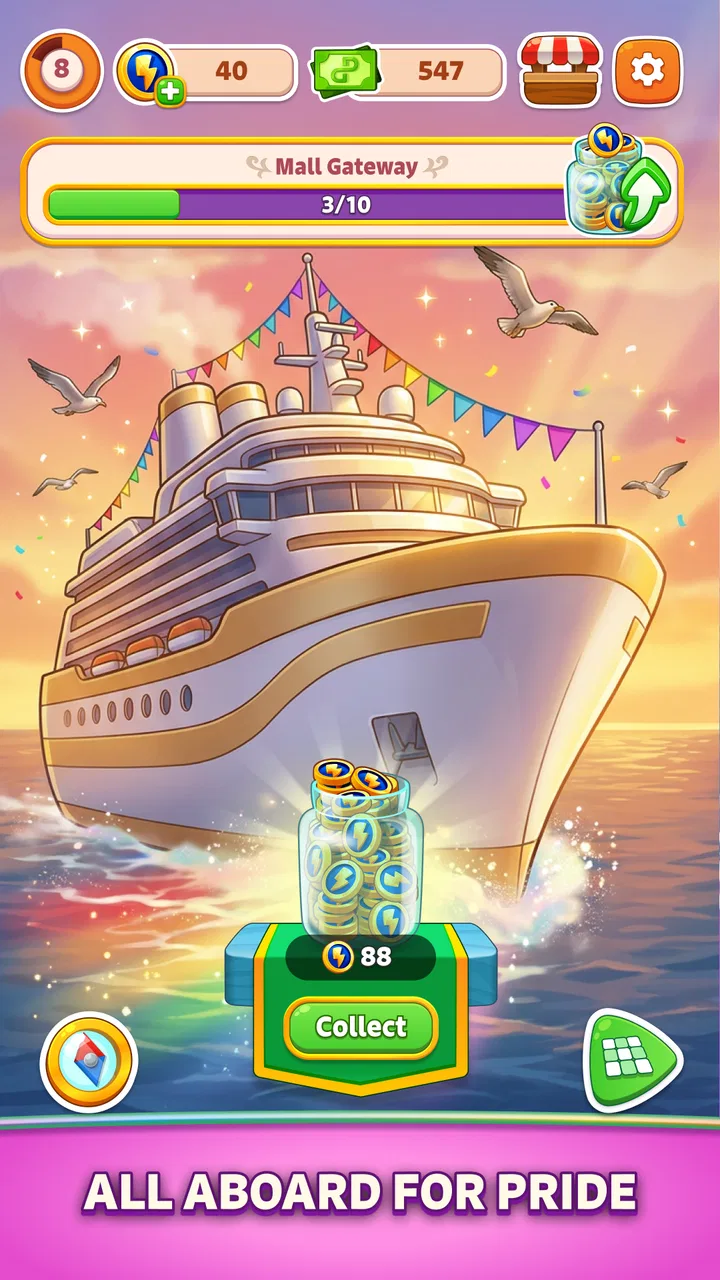
Merge Cruise: Mystery Puzzle puts a light, story-driven spin on the familiar merge-and-match puzzle formula. I played it as the kind of game you open for a short break, then keep running because the cruise setting gives each small task a reason to exist. Instead of presenting disconnected boards, it frames progression around restoring a ship and gradually exposing the secrets connected to it.
That combination makes it more approachable than a purely abstract puzzle game. You are not only clearing pieces; you are helping move a larger situation forward. The idea is simple enough for casual players, yet the mystery angle gives me a reason to return after a session ends. My overall impression is of a relaxed puzzle game with a stronger sense of place than many typical merge titles, although its long-term appeal depends heavily on how comfortable you are with waiting, repeating familiar actions, and managing optional purchases.
How the cruise setting changes the usual merge experience
The central appeal is the relationship between merging, solving, and renovation. In many games in this category, the board is the entire experience. Here, the board feels like a tool for improving the cruise ship and uncovering what happened around it. That context gives ordinary combinations more purpose, especially when I am deciding whether to spend a newly earned item immediately or hold it for a later objective.
You May Also Like

 Blood Strike: 2.5 Anniversary
Blood Strike’s Loadouts Turn Every Drop Into a Tactical Gamble
A close look at Blood Strike’s custom loadouts: how fast access to signature weapons reshapes its battle royale rhythm, rewards preparation, and narrows the gap between fights.

 Pandora - Music & Podcasts
Pandora’s Music Is Easy to Start, but Harder to Recover
Pandora’s strength is its low-effort path from a seed to a station. Its weak spot is how much confidence it asks you to place in connection, setup, and quiet recovery.

 8 Ball Pool
 Is Built on Rivalries, Rematches, and Routine
A close look at the rivalries, rematches, shared routines, and unanswered safety questions that turn a quick pool match into a persistent mobile community.

 Samsung Music
’s Quiet Strength Is Playing What You Already Own
Its reach comes less from spectacle than from dependable access to a personal library. That simplicity is both the app’s strongest retention engine and its ceiling.

 AccuWeather: Weather Radar
AccuWeather Review: A Quick, Clear Forecast for Everyday Decisions
For everyday plans, the best forecast is the one you can understand quickly. AccuWeather makes rain timing, radar, and local conditions easy to act on, with a few trade-offs.

 Hill Climb Racing
Why Hill Climb Racing Still Turns Crashes Into One More Run
A tiny car, a bumpy hill and one more upgrade: Hill Climb Racing keeps resurfacing because its simple chaos makes every near-miss feel personal.
More From Our News Desk
View All News


I found that the mystery works best as a steady background thread rather than a complicated detective simulation. The game encourages curiosity without asking me to memorize a large cast or follow a dense set of clues. It is a good fit if you like story fragments delivered alongside simple puzzles, but it may feel too gentle if you want demanding logic challenges or a fully interactive investigation.
The renovation layer also gives the game a useful rhythm. A puzzle session produces progress, and that progress changes the ship’s condition or opens another part of the journey. This creates a clearer sense of direction than endless levels with only a score to show for them. I particularly liked having a visual reason to care about completing another task, because it made short sessions feel connected rather than disposable.
Still, the merge formula has familiar limits. The basic actions can become repetitive when several objectives ask for similar combinations. The cruise story helps disguise that repetition, but it does not remove it. Players who enjoy organizing a board and gradually building higher-level objects will probably settle into the loop quickly. Players who need constant mechanical variety may find the pace predictable after the initial discovery period.
What to expect from the pace
The game is designed around gradual progress rather than instant completion. I would not approach it expecting every objective to disappear in one sitting. Its best use is as a regular, low-pressure companion: a few minutes while commuting, a quiet break between tasks, or a longer evening session when I want something undemanding.
One practical tip is to avoid treating every available merge as urgent. I found it more useful to pause and look at the current objective before combining items. Merging simply because a space is available can leave the board less flexible later. Keeping a small amount of room open is especially helpful when several different item types are competing for attention.
This is one of the game’s less obvious trade-offs. Fast merging feels satisfying, but careful merging usually gives better control. The game rewards players who treat the board as a limited workspace instead of a place to clear blindly. That small change in approach makes the experience calmer and reduces the frustration of having useful pieces buried among less important ones.
How it behaves during longer sessions
During heavier play, the main pressure comes from managing the board and the flow of objectives rather than from complicated controls. A player who keeps returning throughout the day may spend more time deciding what to combine, what to save, and which renovation request deserves attention first. The game remains easy to understand, but the number of small decisions can make a long session feel more involved than a quick glance suggests.
I recommend using short sessions when the board begins to feel crowded or when progress starts to slow. Closing the game and returning later can make it easier to reassess the available pieces instead of forcing combinations just to create space. This is also a useful habit for anyone who dislikes making impulsive choices with limited resources.
The cruise theme helps during these longer sessions because it breaks up the puzzle routine with a broader sense of movement. Renovation goals give the player something different to look at, while the mystery provides a reason to continue. Even so, the underlying interaction remains deliberately repetitive. If you want a game that constantly introduces new rules, this will probably feel restrained rather than exciting.
Another useful distinction is between relaxing repetition and frustrating repetition. Merge Cruise sits closer to the relaxing side when I play without rushing. It becomes less comfortable when I expect rapid advancement or try to finish every available task immediately. The game is better suited to steady progress than to marathon completion.
Stability and recovering after interruptions
For a casual mobile game, reliability matters because many sessions happen in small gaps. I prefer a title that lets me return to the same activity without demanding a long setup each time. Merge Cruise is naturally suited to that pattern: its puzzle structure can be approached in brief visits, and the renovation and mystery elements provide a clear point to resume.
I would still use a simple recovery habit: finish an obvious action, allow the game to settle, and then leave rather than closing it in the middle of a major transition. That is sensible for any progress-based game, particularly when playing on a busy connection or moving between apps. It also makes it easier to remember what the current objective was when returning later.
The game’s casual design is helpful if your device is not always available for long periods. You do not need to reserve an entire evening to appreciate it. A realistic example would be playing while waiting for an appointment: I can inspect the current request, make a few careful merges, use the resulting progress on the ship, and stop before the session becomes repetitive. That is a better match for the game than expecting a complete chapter during one break.
There is an important difference between a game being easy to resume and a game being ideal for every offline situation. I would not choose it solely as a travel game unless I had already checked how it behaves in the conditions where I plan to play. The most dependable approach is to begin a session with a stable connection and avoid assuming that every part of a progression-based title will behave identically without one.
Device requirements and practical expectations
The Android release supports devices running at least Android 7.0, which places it within reach of many older phones and tablets. That does not guarantee identical smoothness on every model, however. Performance can still depend on the device’s age, available storage, background activity, and how many other apps are competing for memory.
Because the game combines a puzzle board with a decorated cruise environment, I would keep reasonable expectations on entry-level hardware. A newer device should be the safer choice for players who care about responsive transitions and comfortable longer sessions. On an older phone, closing unused apps first is a sensible step, especially if the device already slows down when several programs remain open.
Resource-conscious players should also remember that visual progression can encourage longer sessions than a basic puzzle app. If your phone has limited battery life, the practical cost may come less from a single short round and more from repeatedly checking the ship throughout the day. I would treat it as a moderate casual game rather than something to leave open continuously.
The current version is 0.37.950. When deciding whether to install it on an older device, I would look at the operating-system requirement first, then consider how comfortably that device handles other visually presented games. The minimum system version tells you whether installation is possible; it does not promise that every older handset will feel equally quick.
Who will enjoy it, and who should skip it
I think this is a strong match for players who like merge puzzles but want a setting and a reason behind the tasks. It also suits people who enjoy renovation themes, gentle mysteries, and progress that can be made in small pieces. Families may appreciate the accessible presentation, and the content rating is Everyone, making the game broadly approachable from an age perspective.
It is less suitable for someone searching for a pure brain teaser with difficult deduction. The mystery supports the puzzle loop, but the game is not best understood as a demanding case-solving experience. Likewise, players who dislike energy-style pacing, repeated collection, or optional spending should approach carefully. Even when the core download is free, the surrounding structure can still encourage purchases.
The price is free, while in-app purchases range from $0.99 to $199.99 per item. That wide range is worth noticing before starting. I would recommend deciding on a personal spending limit in advance and treating purchases as optional convenience rather than part of the basic definition of success. If you prefer games with one clear upfront payment and no temptation to spend during play, a paid puzzle title may be a better alternative.
Compared with a traditional match-three game, this one offers more environmental progress and a stronger narrative reason to continue. Compared with a pure merge game, it places more emphasis on the ship and its secrets. Compared with a dedicated mystery game, it gives you less investigative depth but a more relaxed, tactile routine. Those comparisons explain its position well: it is a middle ground for players who want several gentle layers rather than one highly specialized system.
Small strategies that improve the experience
My first recommendation is to read the current task before spending the board’s most useful pieces. A visually attractive combination is not always the most valuable one. Saving flexible items can prevent a later bottleneck, particularly when a renovation request asks for something that takes several steps to build.
Second, use the ship’s renovation goals as a planning tool rather than merely a reward screen. When I know what kind of progress I am working toward, I make fewer random merges. This turns the board from a place where I simply remove clutter into a short-term planning exercise.
Third, separate “I have room” from “I should merge now.” Empty space is useful, but filling it immediately can make the next decision harder. I found that leaving a buffer gives me more options and makes the board feel less stressful. This is a small habit, yet it changes the game’s texture more than rushing through every available action.
Finally, use the mystery as a pacing signal. If I am continuing only because I feel obliged to clear one more objective, that is usually a good point to stop. The game is more enjoyable when the story and renovation provide motivation, not pressure. Returning with a fresh view of the board is often more satisfying than forcing a tired session.
My final performance verdict
PeerPlay has built a free puzzle game that is easy to approach and more distinctive than a bare merge board. Its cruise setting, renovation goals, and mystery thread work together to give routine combinations a sense of direction. I found it most appealing in short, repeatable sessions where I could make a few thoughtful decisions and leave with visible progress.
Its limitations are equally clear. The core actions can become repetitive, the pace is not aimed at instant advancement, and the optional purchase range means budget-conscious players should stay alert. Older devices may also require more patience, even though the Android requirement begins at version 7.0. These are not automatic deal-breakers, but they define the audience that will enjoy it most.
The game has passed the half-million-install mark, which fits its position as an accessible casual title rather than a niche experiment. I would recommend it to a friend who wants a calm merge puzzle with a setting to explore, especially if that friend enjoys checking in several times a day instead of finishing everything at once.
My recommendation is simple: try it if you want relaxed ship renovation and a light mystery wrapped around merging. Skip it if you need deep detective work, demanding logic puzzles, or a completely purchase-free experience. For the right player, Merge Cruise: Mystery Puzzle is a pleasant slow-burn game whose strongest feature is not any single merge, but the feeling that each small action is helping restore a larger story.
FAQs for Merge Cruise: Mystery Puzzle
01What is the main objective of Merge Cruise: Mystery Puzzle?
Merge Cruise: Mystery Puzzle is a game where players merge various items to solve puzzles and unravel mysteries. The primary goal is to strategically combine items to progress through levels and uncover hidden secrets within the game. Each level presents unique challenges that require creative problem-solving.
02Is Merge Cruise: Mystery Puzzle free to play?
Yes, Merge Cruise: Mystery Puzzle is free to download and play. However, it contains in-game purchases that can enhance the gaming experience. These purchases are optional, and players can enjoy the game without spending money, although some features might be more accessible with purchases.
03What are the system requirements for Merge Cruise: Mystery Puzzle?
Merge Cruise: Mystery Puzzle requires iOS 11.0 or later for Apple devices and Android 5.0 or higher for Android devices. It is optimized for both smartphones and tablets, ensuring a smooth gaming experience across different device types. Ensure your device has sufficient storage space for the app to run efficiently.
04Does Merge Cruise: Mystery Puzzle require an internet connection?
While Merge Cruise: Mystery Puzzle can be played offline, some features, such as special events and in-game purchases, require an internet connection. Playing online also ensures that your progress is saved and synchronized across devices. For a full experience, an internet connection is recommended.
05How does the game handle player data and privacy?
Merge Cruise: Mystery Puzzle adheres to strict privacy policies to protect player data. It collects minimal information necessary for gameplay and offers transparency about its data usage. Players can review the privacy policy within the app or on the developer's website to understand how their information is managed.
Pros
- Engaging storyline keeps players curious.
- Intuitive controls for easy gameplay.
- Variety of puzzles to challenge users.
- Regular updates with new levels.
- Visually appealing graphics and design.
Cons
- In-app purchases can be pricey.
- Some levels feel repetitive.
- Occasional ads disrupt gameplay.
- Requires internet connection.
- Progression can be slow without spending.

Merge Cruise: Mystery Puzzle
Gallery